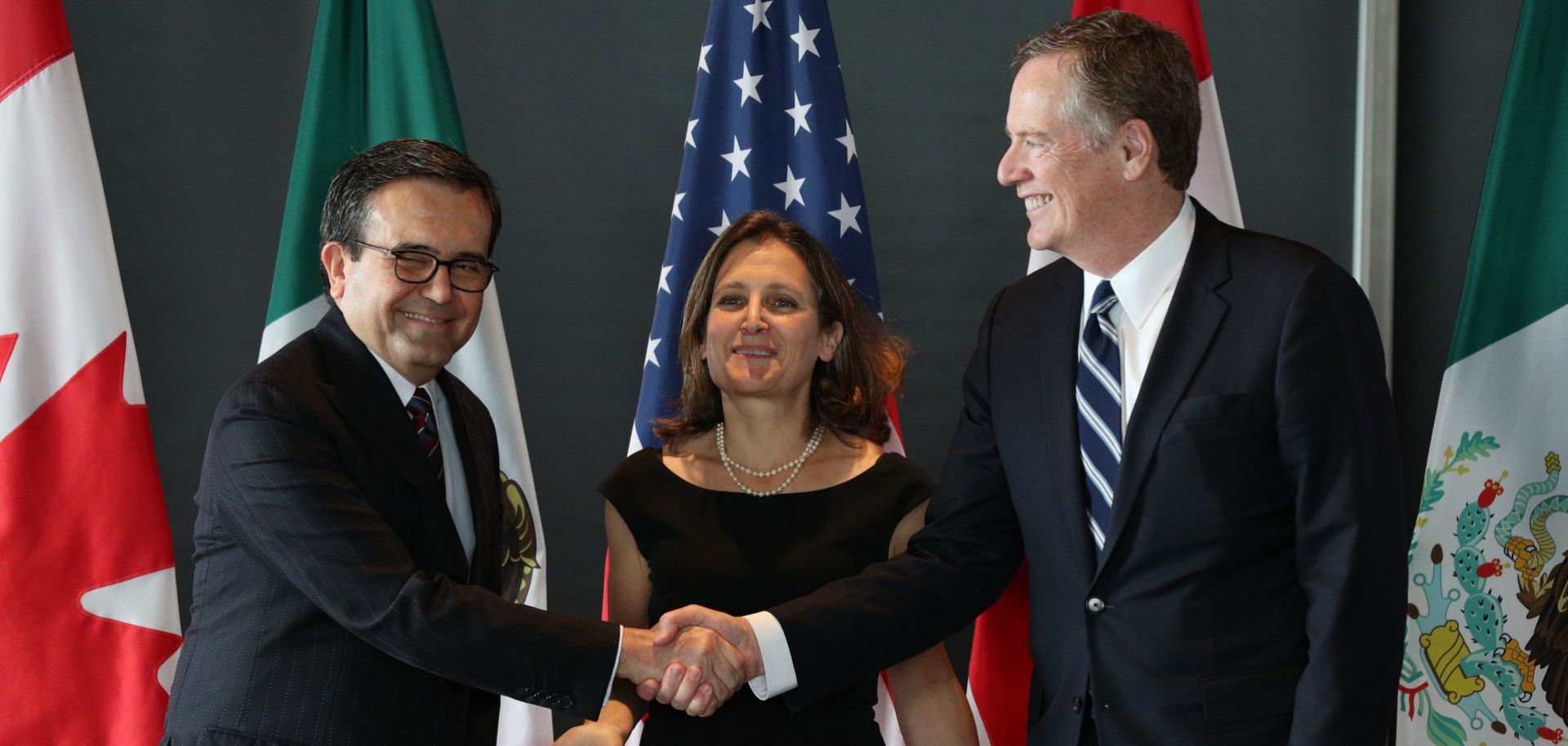
With renegotiations of the North American Free Trade Agreement fast approaching, Stratfor Vice President of Global Analysis Reva Goujon sits down to discuss the future of NAFTA and global trade in this episode of the podcast. She’s joined by Senior Global Energy Analyst Matthew Bey, Latin America Analyst Reggie Thompson and Senior Science and Technology Analyst Rebecca Keller for context on what this renegotiation could mean for North America and more broadly, the future of global trade.
Transcript
Faisel Pervaiz [00:00:00] Hello, I'm Faisel Pervaiz, a South Asia analyst here at Stratfor, and this podcast is brought to you by Stratfor Worldview, our premier digital publication for objective geopolitical intelligence and analysis. Individual, team, and enterprise memberships are available at worldview.stratfor.com/subscribe.
Ben Sheen [00:00:33] Hello and thank you for joining U.S. for this edition of the Stratfor Podcast, focused on geopolitics and world affairs from Stratfor.com. I'm your host, Ben Sheen. After more than 20 years, the North American Free Trade Agreement, or NAFTA, will soon get a second look. Following strong rhetoric during U.S. Presidential campaign, the Trump Administration is now formally looking to renegotiate the deal, and has issued broad goals for what it wants a reshape deal to look like. In this episode of the Stratfor Podcast, we dig into what the future truly holds for NAFTA, and global trade deals in general. To explore what changes could really be in store and what their impact could be, Stratfor Vice-President of Global Analysis Reva Goujon, sits down with Senior Global Analyst Matthew Bey, Senior Science and Technology Analyst Rebecca Keller, and Latin American Analyst Reggie Thompson. Thank you for joining us.
Reva Goujon [00:01:25] Hello, I'm Reva Goujon, and I'm joined by my colleagues here, Matthew Bey, Reggie Thompson, and Rebecca Keller. And given that the North American Free Trade Agreement is set to kick off in its renegotiation cycle starting August 16th with the first round, we are here to discuss NAFTA and its future. Now, this free trade agreement has been in existence for more than 23 years. It took three presidents to negotiate it, all with an eye toward tighter North American integration. And lots has happened in those morning couple decades. We've seen a quadrupling of trade overall on the continent itself. We've seen major evolutions in trade globally with very tightly integrated supply chains developed where single good can pass borders multiple times in production prior to final consumption. We've seen things like the U.S. shale boom completely and dramatically altering the energy landscape on the continent, while Mexican oil production has essentially plateaued. Since the global financial crisis we've seen a leveling off of migrant flows from Mexico to the United States. Now, given all this change over this long period of time the argument that this agreement needs updating is not something peculiar to this U.S. administration, although we have seen some, a lot, of protectionist rhetoric coming out of this White House that certainly has garnered a lot of attention. But our core forecast since President Trump has come into office is that the reality will not end up matching the rhetoric and that moderation would ultimately prevail. Now Matthew we've already been seeing signs
Reva Goujon [00:03:15] of that moderation trend in play just as these negotiations about are about to kick off. What have we really seen come out of this administration just in these recent weeks even.
Matthew Bey [00:03:25] We need to start back when the Trump Administration in March kind of gave a first draft of its priorities that it wanted to do in their negotiation and included a lot of language it was pretty aggressive at the time. One of the things that we kind of, you know, highlighted as being a significant issue was the concept of equal tax treatment. So that was the idea of Mexico in particular having a VAT which would essentially from the Trump Administration argue that they have a export subsidy and there would be a way to counter veil that to level the tax playing field, and that could be a way to justify a 20% import tax or something like that. We seen that rhetoric kind of basically disappear. We saw the new NAFTA priorities list come out last week and that wasn't even on there. That doesn't mean that the White House has completely gone away from its protectionist rhetoric, but it's been moderate as you said. And that's the significant thing that we've seen there. And the whole idea of updating NAFTA, it's, like you said it's not unique to Trump. This is actually something that was a huge debate in the 2008 election cycle both Hillary Clinton and then candidate Barack Obama actually had that as a key part of their platform. And we actually saw in some degree you can argue that that the Obama Administration actually achieved that objective they did that through TPP. TPP was a much broader relationship than NAFTA, it included a lot more countries, it wasn't just three,
Matthew Bey [00:04:47] but included a lot of of updates to what NAFTA was in a lot of areas that would superseded NAFTA. Now, obviously Trump has a very different tone he got rid of TPP that's not going to happen. But we look at the different ways that the USTR now, so the U.S. Trade Representative, wants to update NAFTA we see hallmarks of TPP in some ways. We some see some differences, some hallmarks. And we can basically drop these into three buckets that the U.S. is trying to look at. And at the core of it, is still this idea of reducing the trade deficit in whatever ways possible. That was not a core objective of the Obama Administration. When negotiating TPP and he couldn't make an argument that the TPP might've actually added to the trade deficit. Whether that's good or bad for the economy that's obviously a very sticky subject in the United States.
Reva Goujon [00:05:32] And obviously complicated given these very integrated supply chains.
Matthew Bey [00:05:35] Right and speaking of the integrated supply chains one of the core issues in that bucket is what are called Rules of Origin. Rules of Origin are basically laws and licenses that basically allow you to qualify for being part of getting free trade access. In the case of, for example, a car these are generally around 45%, so that means you have to have 45% of the parts value produced in NAFTA countries to then be eligible for NAFTA. This would actually going to be lowered under TPP. Trump's White Houses has actually decided to try to make it to strengthen in those rules to make it actually even higher standards to get involved in NAFTA. The argument there would be by boosting that, boosting these requirements to go say 70% or 75% whatever the number finally ends up being that then boosts regional manufacturing. Some of that's going to happen the United States. That might mean that the trade deficit between the United States and Mexico may not go down because of it but the United States trade deficit with the rest the world or NAFTA's trade deficit with the with the rest of the world might go down.
Reva Goujon [00:06:35] And that's where that North American integration trend stays very much on track. Let's go back to your earlier point though. When we talk about what is being gleaned from the Trans Pacific Partnership or TPP framework how we see those elements being applied to this NAFTA renegotiation.
Matthew Bey [00:06:53] The first bucket that we were talking about was this idea of boosting U.S. exports, limiting U.S. imports and reducing the U.S. trade deficit. The second bucket, however, deals with updating NAFTA to the 21st century. TPP was an agreement that was supposed, consider to be relatively revolutionary in a lot of ways. It included a lot of things that were not a part of previous multilateral big trade agreements. Which is why it took so long to negotiate, and why it was a very difficult negotiation. Because working through these deals or these different details for the first time was kind of significant. Some of these will include stronger IP rights so intellectual property, including digital trade. So one of the things that the White House wants to make sure is that we don't start to see trade barriers such as tariffs on digital trade that goes between Mexico, United States, Canada, United States, et cetera. Then just broadly speaking trading services to begin with. A key aspect of this and this plays into a number of different issues, I mean IP isn't so much just related to the digital sector or the trade services sector, but it's a broader issue in this concept of IP rights that falls into things like manufactured goods or agricultural goods. Agricultural is an interesting aspect of what we're going to see in the NAFTA negotiations.
Rebecca Keller [00:08:07] Absolutely Matthew, it's agriculture along with manufacturing has been targeted as one of the key focuses of this renegotiation, and the agriculture industry, in general, has been a little on edge, given the uncertainty. But as far as IP rights go that's where the future of agriculture is with genetic engineering, with, precision agriculture and the use of big data to improve agricultural meshes. Incorporating those kind of updates will be key to continuing the agricultural trade relationship with the NAFTA and the North American integration, specifically I think we can look at TPP as a model for what's reasonable in terms of updated agricultural trade agreements and that we'll be looking at biotech, reducing or eliminating non-trade tariff barriers for biotech. That's really in the U.S.' best interests as one of the leaders in genetic modification, genetic engineering technology, and the other thing we'd look at is reform or cooperation in phytosanitary procedures so there's no incongruency between countries there.
Matthew Bey [00:09:15] Yeah and that last point was actually one of the key, just broader points that the Trump Administration has actually outlined five or six different conditions that they were going to try to be negotiating on. But, one things that you mentioned kind of as an aside comment. That I want to go back to, was this concept of big data. The idea of data being a new commodity is something that has grown quite significantly over the last five years at least. That was one thing the obviously did not exist When NAFTA was negotiated in the early 1990's, late 1980's. So can you tell me how that actually has become much more of an integral part of the international economy, and more specifically the NAFTA economy.
Rebecca Keller [00:09:50] When you're looking at increased automation and how technology is changing, how every industry functions right now, you can't ignore the fact that it's all based on data. And the data is the commodity as you said. And if we don't account for that in new trade agreements, they're not going to be relevant five, 10 years down the road.
Reva Goujon [00:10:10] In many ways this NAFTA renegotiation is going to be breaking new ground and setting precedents for how digital trade will be incorporated into free trade agreements that go well beyond this one.
Matthew Bey [00:10:20] I think so, but TPP kind of already did that to a certain degree because it included those aspects Now obviously Trump's going to have a different slant on it, that's fine, but it is something that we're going to see as the model trade agreement. It's interesting to look at this, if we talk about TPP and then maybe now this NAFTA renegotiation being a model agreement. Or maybe the free trade agreement that's currently ongoing negotiations between the EU and Japan, is that these are model agreements, so is NAFTA if you think about it way back when is NAFTA was this first multilateral trade agreement. To predated WTO for instance. So it is now a common theme that we're starting to see is that sometimes we see these kind of landmark trade agreements coming and that redefined the way that people view trade agreements and that's kind of one of the reasons why people are so interested in TPP or NAFTA From a broader viewpoint than just the old standard trade is in goods and that kind of thing tariffs, stuff like that. And finally, the last bucket of the United States policy is this idea of reasserting national sovereignty. Now this was not something that the Obama Administration had put on a high footing. This is something that is very clear about the Trump Administration's policies when we look at this whole nationalistic rhetoric, the whole nationalism, identity that Trump embodies in many ways. There are kind of two really key things and these could be actually relatively sticking points when we talk about actual negotiations going forward.
Matthew Bey [00:11:39] One of them is eliminating this global safeguard restriction. This is very controversial because right now if the United States were to put in safeguard measures. A safeguard measure is essentially temporary import restrictions on a very specific, narrow, category of products where an industry has had undue harm or significant harm that is not expected. Right now if the U.S. were to put these measures into place Canada and Mexico would not would not be under them. Usually these are to protect your industries when they have problems. The Trump Administration wants to make sure that if there is a problem, Canada and Mexican imports can actually go under this global safeguard. Now, safeguard mechanisms are a really interesting thing, we talk about the WTO if the Trump administration actually tries to put into place safeguard mechanisms, even without this global safeguard restriction, that's going to be challenged by the WTO. Not only possibly by Canada or Mexico, but the E.U. or whoever is affected the most. And this is actually something where the Trump Administration might actually lose a case.
Reva Goujon [00:12:39] In other words under that protectionist and more Nationalist orientation of this administration, safeguard mechanisms is a key tool that we can expect to be used or attempted to be used in trying to level out that playing field so to speak. Even within, then NAFTA.
Matthew Bey [00:12:52] Right.
Reva Goujon [00:12:54] With Canada and Mexico.
Matthew Bey [00:12:54] The question is will it work? Then that brings up a debate that's that's really broader than just NAFTA which is Trump going to be doing with the WTO? That is a really significant thing. And then the last issue that is a significant one, is the Chapter 19 settlement mechanism. The chapter 19 settlement mechanism allows for anti-dumping and countervailing duty investigations to go before a binational panel instead of going through the domestic court system. This is something that Canada in particular and then also considering that Mexico really wanted to get in into the deal in the first place. Canada's lead negotiator during the 1980's basically has said that was the sticking point. If we didn't have that we might have signed the deal. This is a thing where the Trump Administration wants to bring back these investigations within the NAFTA countries, back to the U.S. court system. That does definitely play into making sure that the U.S. laws are applied without having to go to a body that's not U.S. nationally dominated or US-centric. That very much fits into this this whole idea of reasserting national sovereignty.
Ben Sheen [00:14:05] We'll return to our conversation on the future of NAFTA. When Stratfor's Reva Goujon, Matthew Bey, Rebecca Keller and Reggie Thompson in a few moments. But if you're enjoying the conversation be sure to visit is us at worldview.stratfor.com. Global trade economic development and the chief political constraints facing nations. Our issues are explored daily in a published analysis, reflections and partner commentaries. As well as our quarter, year and decade forecasts. If you're not already Worldview member, consider subscribing if you want sober, unbiased analysis on in these issues and broader world affairs. Individual, team, and enterprise subscriptions are available at worldview.stratfor.com/subscribe. We'll also include our link in the show notes. Now let's get back to the second part of our conversation on the future of NAFTA.
Reva Goujon [00:15:03] Mexico now let's see from the Mexican perspective on how it's viewing this renegotiation. The key sticking points, talking points and what is its strategy moving forward Reggie?
Reggie Thompson [00:15:14] From the Mexican perspective the main priority in the lead up to the talks, has been to find ways in which it can shape the talks to try to move them towards its desired outcome, which is to maintain preferential access to the U.S. market. Mexico is relatively weak in these negotiations, compared to the United States, simply because the Mexican economy relies so much on the United States domestic market for its export growth of things like Mexican manufacturing is deeply integrated into United States supply chains and it depends greatly on growth in the United States market. But essentially what we've been seeing is Mexico moving from, essentially, surprise after the election of Donald Trump to seeking avenues with which to shape the negotiations. Things like lobbying in the United States, bilateral visits, meetings with governors of states that would be negatively affected by the disintegration of NAFTA for example. And so all of this has really been how Mexico has moved to try to lobby for its preferred outcome. It's also hung the threat so to speak, of importing more agricultural products from South America from Brazil, from Argentina, from Uruguay, the states that make up the common market of the south in case NAFTA falls apart. so this negative effect on U.S. agriculture is something that Mexico has held up as a potential negative side effect of failing to engage in NAFTA talks. And so far Mexico has been rather successful in this. The United States is moving towards a more moderate stance
Reggie Thompson [00:16:48] both because of its own internal domestic politics but also because Mexico has made the negative aspects of pulling out of NAFTA rather rather prevalent. It's it's attracted it's drawn visibility to these, so to speak, in recent months.
Reva Goujon [00:17:03] And on the agricultural front though, it's not just a threat we've actually seen Mexico actually follow through in trying to develop those agricultural links further south.
Reggie Thompson [00:17:14] Exactly, Mexico's obviously they're hoping for the best, but preparing for the worst in a certain sense. And diversification of trade away from the United States no matter how slow, is something that's high on the priority of the Mexican government. We've seen Mexico start discussions with countries like Argentina and Brazil, to try to increase shipments or excuse me, imports of agricultural products. Things like beef, soy, corn, pork all products that the United States exports to Mexico. The Mexicans are looking to get these in Argentina and Brazil as well. Simply because of Brazil's growing exports of soy we started to see Brazilian soy making inroads into Mexico and that's probably set to continue for coming years.
Reva Goujon [00:18:00] And Rebecca this is something you've been tracking very closely given that it's a big concern for a number of agricultural producers in the United States. As you put it earlier in conversation, we know millennials love their avocado toast and there are a number of key products here at stake if Mexico, depending on how far Mexico can go in and supplementing trade with the United States.
Rebecca Keller [00:18:26] Right and I think that's where it's a very important distinction to make pulling out of NAFTA verses renegotiating NAFTA. NAFTA completely changed how American's ate. Basically introduced a lot more fruits and vegetables into everyday diet you have access to certain things year round now, they're cheaper. And that flow went the opposite way to Mexico. When you look at that 25-year relationship that's not going to break overnight. You've got livestock operations that cross borders. You've got animals that are born in Canada or animals that are born in Mexico that are then shipped to the United States to be processed. And then shipped back to those countries to be consumed. So that's not going to break down overnight, but then, as you see, Mexico is preparing for the worst. Which would be a pull out from NAFTA. That being said the agricultural industry in the United States does favor a renegotiation of NAFTA. And that goes back to the point I was making earlier about the increased automation, increased technological reliance on the agricultural industry in the United States. And how trade negotiations and trade deals need to be modified to address that in agriculture and other industries moving forward.
Reva Goujon [00:19:38] Even as were seeing moderation in the details of this renegotiation, there is still a heavy layer of Nationalist and protectionist rhetoric coming out of the White House. Naturally, that has an effect across the border in Mexico. Reggie, what's the political dynamic that we've been seeing developing in Mexico City in what is already election season over there.
Reggie Thompson [00:20:00] It's important to note that the NAFTA renegotiation process is going to overlap significantly with the Mexican 2018 presidential electoral season. And so what we've been seeing so far and we're going to continue seeing is a Nationalist backlash in Mexico. That Nationalist backlash is probably going to benefit Andrés Manuel López Obrador who is, he's not an outsider politician but he is the head of the upstart National Regeneration Movement. He formerly ran twice on the party of the Democratic Revolution ticket for President, narrowly losing the first time to Felipe Calderón of the National Action Party. So, López Obrador is a concern. Particularly for the private sector in Mexico and the United States because he's an unknown quantity. He's never held a public office in Congress for example. He's never held a cabinet position and he's definitely never been president. And so to some degree the private business sector in both countries, they don't really know what to expect with him. But with with López Obrador what we're going to be seeing is even if he is more leftist or populist in orientation than other potential presidential candidates. If he comes to power he's going to be constrained by Mexican institutions simply because even if he's president he may not have a majority in Congress. It would be very difficult for his party given the fragmentation in Mexico among four major political parties. It will be very hard for that party to gain a majority in Congress. While things like presidential directives to change specific aspects of energy reform for example,
Reggie Thompson [00:21:41] the pace of bidding rounds, things like that, would be possible it would be harder for him to affect things that fundamentally influence the economic relationship with the United States or the political relationship with the United States. For example, energy reform would not be fundamentally changed under a López Obrador government. The constitutional underpinnings and the legislative underpinnings would not be changed. Still this could have an effect because taxation and the pace of bidding rounds, pertaining to energy reform, that would definitely be in the president's power to change. Moving out of the economic realm and more into the realm of security and political interests for the United States. Things like the security strategy what Mexico does in countering drug cartels for example. It would be very hard for López Obrador presidency to change that unilaterally without just running into a lot of resistance domestically. As we were saying, a Nationalist backlash could end up in a Nationalist candidate being elected in Mexico. But his power would most decidedly be limited. He would not be able to simply come in to power and fundamentally change the way Mexico works. He'd definitely have to work within the institutions and we'd see a moderating effect. Much like what we've seen in the United States with President Trump.
Reva Goujon [00:22:59] Right, I mean there is certainly effects that can be drawn from a more difficult president in Mexico and more difficult relations between the United States and Mexico overall. Certainly a number of investors are going to be looking at a potential an Obrador win and looking at just how many regulatory hurdles for example, they're going to have to cross and just looking at the investment climate overall. But, as you say, those institutional constraints and I'm sure our listeners have been hearing that word a lot, it is something that's very much embedded in our geopolitical model, in making sure that when we do see extreme rhetoric that sets the world on edge as we certainly have seen over the course of this past year. To really hone in on what are those limitations, those institutional constraints that ultimately are likely to moderate, the final result, the policy direction in the end. And certainly I think this NAFTA renegotiation fits into that category. Now this is something that not only you know observers and stake holders on the north American continents are going to be following closely, but other trading partners with the United States as well. There's already efforts under way to kick off a renegotiation of the U.S. South Korea free trade agreement. The UK and the midst of its Brexit negotiations with the European Union is also trying to get informal talks going on a free trade agreement with the United States. A number of countries are going to be looking at this NAFTA renegotiation as a precedent.
Reva Goujon [00:24:39] For how their own trade negotiations will go. And again what elements, those moderating elements that we see, and modernization elements that we see, get drawn from the Trans Pacific Partnership negotiation that may be dead in the United States but remains very relevant in these trade negotiations over all. Our team will be watching very closely on Stratfor Worldview and we thank you for joining us today.
Ben Sheen [00:25:12] That concludes this episode of the Stratfor PodCast. If you enjoyed today's conversation be sure to catch up on the latest analysis on this and related topics on worldview.stratfor.com. We'll include links to related analysis in the show notes. And if you're not already a member, be sure to subscribe to the unparalleled insight from Global Trends Now with forecasts on future developments. If you have a question or comment about a podcast or even an idea or a future episode, let us know. You can call us at 1-512-744-4300 extension 3917. Or reach us by email at podcast@stratfor.com. Don't forget to leave us a review. We really appreciate your feedback. Your review also helps others to discover the podcast. It just takes a few moments, you can leave a review on iTunes or wherever you subscribe to the podcast. And for more geopolitical intelligence, analysis and forecasting that brings global events into valuable perspective. Follow us on Twitter @Stratfor. Thanks for listening.