A look at what the coming week will bring -- and a list of recommended Stratfor articles from the week that was.

A look at what the coming week will bring -- and a list of recommended Stratfor articles from the week that was.
Vaccines for children will relieve not just families, but caretakers, coaches and teachers.

Stay informed about the significant meetings and events Stratfor analysts at RANE are tracking.

Arab Gulf states’ close ties with the military will impede EU and U.S. efforts to put Sudan’s democratic transition back on track.

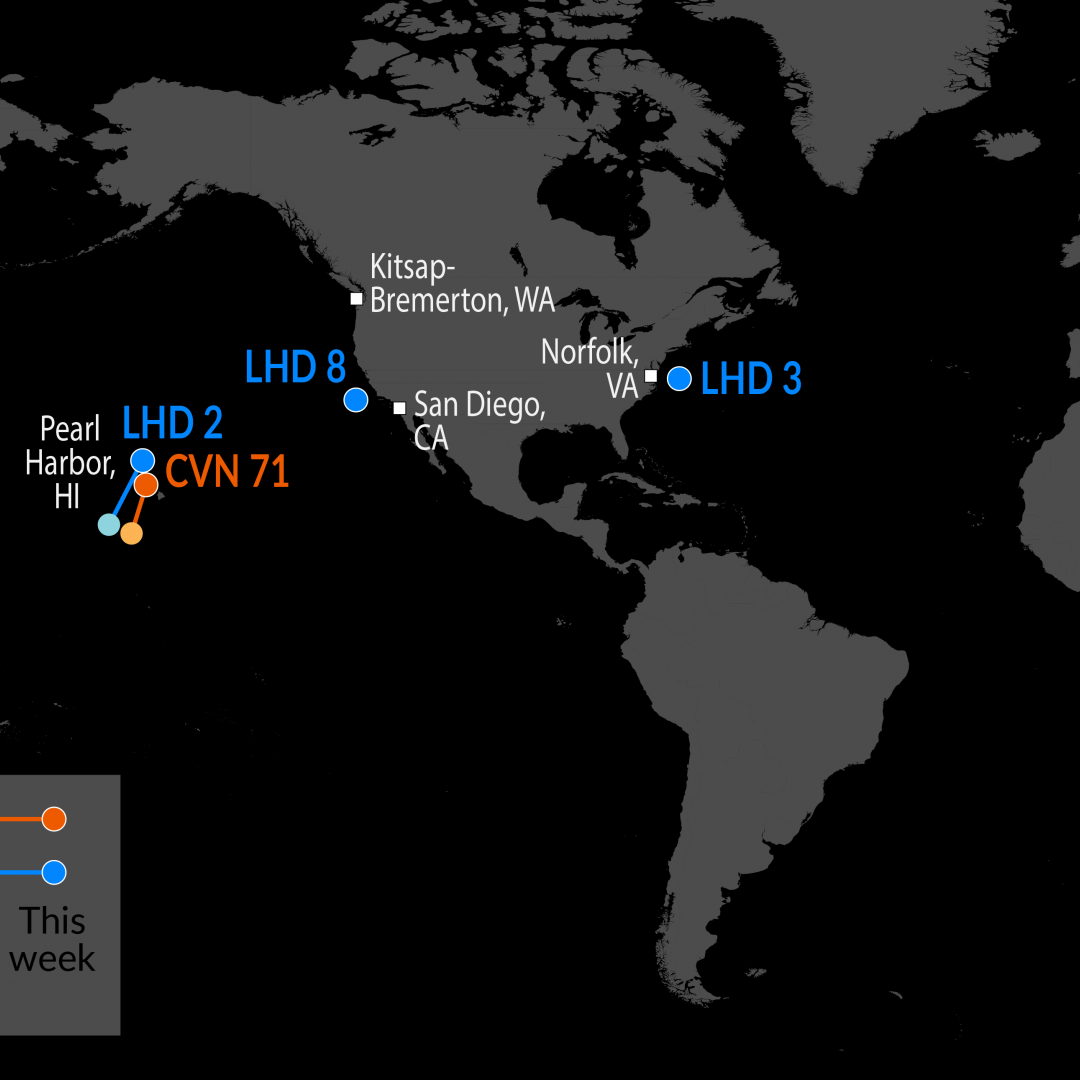
This map shows the approximate locations of U.S. Carrier Strike Groups and Amphibious Ready Groups.
As Europe prepares for winter amid a complicated energy crisis, Russia is holding back on shipping natural gas to the region.

Forcing parents to feed their kids state propaganda could cross the line for the majority of Chinese citizens who are apathetic about Beijing’s political campaigns.
More nations are revealing their plans for future energy use ahead of the U.N. Climate Change Conference, which will be held from Oct. 31 to Nov. 12 in Glasgow, Scotland.

The takeover will likely trigger months of violent unrest, threatening the country’s transition to civilian rule and, in turn, its access to international financial aid.
While India offers many positives for global businesses, good intelligence on where to locate is critical.

A look at what the coming week will bring -- and a list of recommended Stratfor articles from the week that was.

Stay informed about the significant meetings and events Stratfor analysts at RANE are tracking.

While new Gazprom contracts and Nord Stream 2’s certification are likely, Moscow’s coercive tactics risk accelerating Gazprom's decline in Europe’s energy market.

Arab Gulf states’ close ties with the military will impede EU and U.S. efforts to put Sudan’s democratic transition back on track.

This map shows the approximate locations of U.S. Carrier Strike Groups and Amphibious Ready Groups.

Forcing parents to feed their kids state propaganda could cross the line for the majority of Chinese citizens who are apathetic about Beijing’s political campaigns.

A look at what the coming week will bring -- and a list of recommended Stratfor articles from the week that was.

Targeting individual hacker groups like REvil will ultimately risk playing into Russia’s hands by distracting the U.S. and its allies from other Russian cyber activities.

Any unrest triggered by the new settlements could finally push the U.S. to take action against Israel’s aggressive behavior toward Palestinians.

Such a compromise would grant Warsaw billions of euros worth of EU funding without addressing the deeper issues regarding the primacy of EU law in the country.

Despite the recent confirmation of U.S. troops in Taiwan, China is still more likely to seek military reunification in the long term, not the short term.

The takeover will likely trigger months of violent unrest, threatening the country’s transition to civilian rule and, in turn, its access to international financial aid.

The Chinese e-commerce giant’s entrance into chip design for cloud computing is a step forward for Beijing's semiconductor ambitions, but may result in U.S. restrictions.

Moscow’s response to the Western alliance’s expulsion of Russian diplomats is aimed at undermining transatlantic unity and deterring additional U.S. sanctions.

Looser fiscal rules could promote growth but raise debt levels, while tighter rules could spur unrest and political upheavals in Southern Europe.

A submarine capability would make it more difficult for the U.S. or South Korea to destroy all of Pyongyang’s potentially nuclear-armed weapons in a first strike.

Stratfor Middle East and North Africa Analyst Emily Hawthorne updates the political and economic situation in Algeria.


In this short video Middle East and North Africa Analyst Ryan Bohl discusses three events to watch for this week.


Stratfor explains Uzbekistan's struggle to maintain internal unity while balancing against its regional neighbors and external powers.

In this short video South Asia Analyst Faisel Pervaiz discusses three events to watch for in the week.

Former CIA intelligence analyst Susan Hasler discusses the “ziggurat” model of radicalization that she and her colleague Cindy Storer built and used while working on counterterrorism efforts.

The United States does not have attractive options as far as its military presence in Iraq, but it has workable ones to achieve its strategic and security goals.

By testing ICBMs and powerful nuclear weapons, the North Korean leader has placed himself in a strategic trap that threatens to leave his country at China's mercy.
By Artyom Lukin

Infrastructure projects have helped Beijing build influence across the globe.

The East Asian nation is at the geographical nexus of the rivalry among China, Russia and the United States. It faces a difficult task navigating its precarious position.
By Jeff Goodson

Rather than trumpet Russia's praises overseas, Moscow's propaganda machine is focused more on undermining the Kremlin's enemies.

Abu Mahdi al-Muhandis fought Saddam Hussein, engineered attacks on Western embassies and took on the Islamic State. His death in the same strike that killed Iran's Qassem Soleimani increased local hostility to the U.S. presence in Iraq.

The country's new president is likely to use the questions surrounding the implementation of the 'safe third country' agreement to wrest additional support from the U.S.
By Lino Miani

By sending Turkish troops to defend Libya's U.N.-backed government, President Erdogan hopes to force a cease-fire that will protect his country's oil and gas interests in the Mediterranean and burnish his regional reputation.
By Sinan Ciddi

While there are few obvious historical analogies for the political crisis Britain's scheduled exit from the European Union has precipitated, there is one suggestive parallel -- and it prompts some sobering thoughts.
By Ian Morris

Technology has driven a number of recent major energy finds, but discovery does not always mean that production will follow.

Whether and how people celebrate Christmas is clearly a complicated affair, bearing only a subtle relationship to Christianity itself. The contemporary, increasingly international version of Christmas is less a religious festival than a celebration of affluence, modernity, and above all Westernness. Without anyone willing it, Christmas has become part of a package of Western soft power.
By Ian Morris